
By: Matt Bruce | nola.com | September 20, 2026
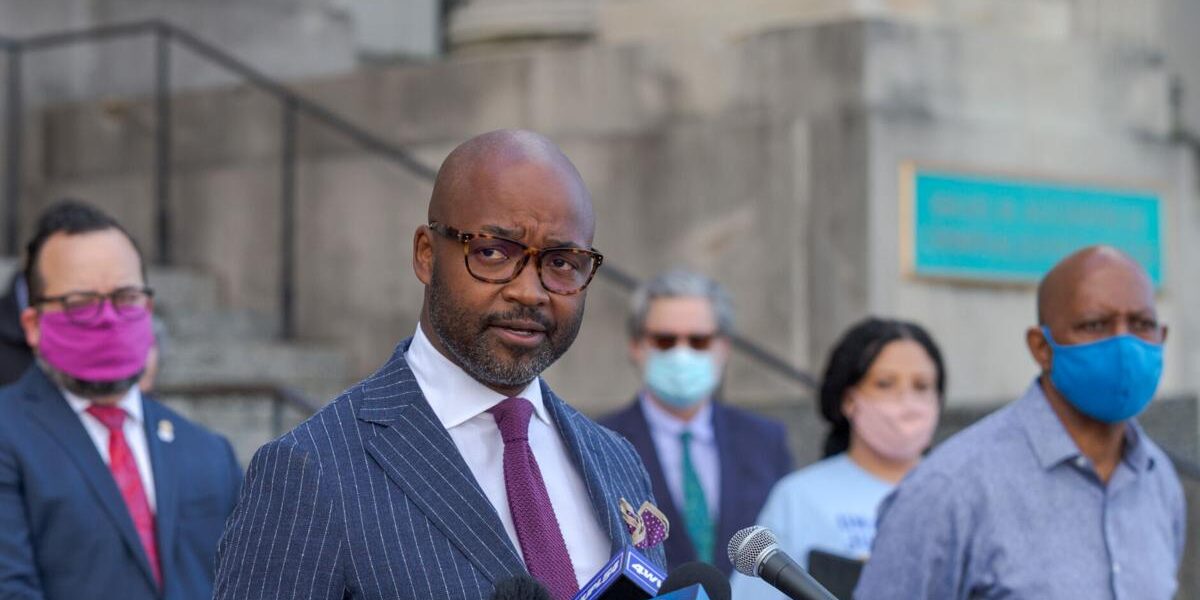
Orleans Parish District Attorney Jason Williams didn’t expect a free ride to a second term.
For six years, the former criminal defense attorney has taken heat from left and right as the city’s top prosecutor, even as violent crime has tumbled from post-pandemic highs. More recently, he’s faced scrutiny from Gov. Jeff Landry and Attorney General Liz Murrill for Murrill’s short-lived criminal indictment, though no evidence has yet surfaced of his involvement.
Yet when the candidate qualifying period ended last month for the Nov. 3 election, no one had signed up to run against him.
According to election records and news archives, Williams is the first New Orleans district attorney to win without a challenger in at least 84 years.
“You know, I’ve been through so much, I expect a challenge when I’m trying to make a cup of coffee in the morning,” he said with a chuckle last month in an interview at Chapter IV, a Creole eatery in the Central Business District.
Williams, 53, slipped into the restaurant like a newly returned friend. Some patrons gathered him in hugs, while others approached his table for banter or a selfie. Williams, grinning, was unburdened by stump speeches or campaign slogans, deemed by New Orleans’ political class as too strong to topple.
He approaches a second term with his popularity having risen locally in tandem with historic declines in crime since 2023, according to annual New Orleans Crime Coalition surveys on views of top elected leaders.
“You attract opposition if you’re perceived as vulnerable, ineffective, someone that might have some weaknesses in their job performance,” said New Orleans pollster and political strategist Silas Lee. “People did not see Jason as vulnerable.”
Crime drop and funding cuts
Williams, a Democrat, ascribes his political tail winds to the crime downturn from 2022, when New Orleans led the nation in murders per capita. Crime overall since then has fallen about 70%. This year, violent crime hit its lowest marks since 1969.
But the view of Williams changes outside the city, and in some corners within it.
New Orleans’ justice system has been targeted for downsizing. There have also been legislative clamps on the DA and judges, and more influence is being wielded by Republican state leaders.
Meanwhile, Murrill is pressing on with a lawsuit aimed at discovering if Williams, or his office, had a hand in her recent indictment. Williams, who had forged a partnership with Murrill to accommodate new State Police patrols in the city, has insisted he properly recused his office from Murrill’s criminal probe.
His biggest challenge now, he says, is managing the consequences of the moves from the statehouse, including $500,000 in cuts this year to funding for his prosecutors.
Williams said political pendulum swings at the “presidential, gubernatorial and mayoral” levels all have impacted his first term.
“It is very political,” he said. “I knew that it would be. I did not realize it would be as political as it is.”
Laura Cannizzaro Rodrigue, a former New Orleans prosecutor under her father, Leon Cannizzaro, and an attorney for Murrill, has remained one of Williams’ most outspoken critics. She was unimpressed with his recent electoral triumph.
“Jason Williams’ reelection without opposition should not be mistaken for a public referendum on his record,” she said in a statement.
“Nor is Williams’ approval rating particularly surprising when much of the meaningful scrutiny of his administration, including his office’s illegal use of post-conviction relief, originated with private citizens rather than the local media,” Rodrigue added.
A series of cuts
Before being elected DA, Williams won high praise as a defense attorney on high-profile cases, including an acquittal for Baton Rouge rap star Torrence “Lil Boosie” Hatch in a 2012 murder trial.
“Probably one of the best trial lawyers I’ve ever seen,” said Tony Clayton, the district attorney for Iberville, Pointe Coupee and West Baton Rouge parishes. The two recently squared off as private attorneys in a dispute between the SEC and former pro players seeking a return to college football. Williams represented the SEC.
After a stint on the New Orleans City Council, as DA, Williams moved to the other side of the courtroom but not out of it. Far more than his predecessors, Williams tries cases personally, including a pair of jury trials in the past few weeks. Williams said he favors complicated cases, particularly retrials, that can tax prosecutors and victims’ relatives.
“It is truly my happy place being in front of a jury, talking to people,” he said. “And it’s a really good way to beta-test the system.”
District attorneys have long wielded vast powers in Louisiana. But in the hands of Williams, who won office in 2020 on a progressive platform, those powers have stirred criticism and political pushback.
Most recently, lawmakers this spring targeted his office and the rest of the New Orleans justice system for cuts. The Legislature abolished three of 12 criminal court judgeships and the criminal clerk in Orleans Parish at Landry’s urging. They reduced state-funded positions in the DA’s office from 83 to 73.
Landry and lawmakers portray them as long-overdue corrections to a court system built for a bigger, more crime-riddled New Orleans. City leaders consider it a power play.
“I just want to make sure we institutionalize the progress that we’ve made so that we never backslide from this public safety success that we now find ourselves in,” Williams said. “I want to create systems that are strong enough to withstand personality changes.”
Williams won his first term running as a reformer, even while under a federal tax fraud indictment for which he was later acquitted at trial. He said walked into a “ghost town” of an office gutted by departures, furloughs and COVID-related budget cuts.
Williams’ prosecutors struggled screening and trying cases. Felony conviction rates fell from 44% under Cannizzaro to 20% in Williams’ first two years, MCC data show. Early supporters, meanwhile, lamented a pivot away from progressive policies amid rampant carjacking and bloodshed.
Later, a Louisiana Senate committee grilled Williams over a civil rights division that has helped free hundreds of long-serving prisoners. Murrill balked, and state lawmakers stepped in to restrict those deals.
“I think there are certain people in the state that don’t believe in fundamental fairness,” Williams said. “They don’t believe in full and equal justice for everybody. And I suppose the Orleans Parish DA’s office, as I’m running it, represents something that they’re not in alignment with.”
Murrill’s prosecutors share the New Orleans courthouse under an agreement Williams initially signed in 2023 with Landry as attorney general.
The accord remains, but relations have soured. Murrill suspects a role for Williams in the July indictment against her on 16 felony counts over letters she wrote to city leaders, including him. Those charges were dropped, and Williams insists he wasn’t involved. Murrill isn’t letting go.
“I think you’re going to continue to see us pursuing transparency around that entire matter,” she said last month.
Murrill said Friday that the two offices will continue to coexist at the courthouse, but she offered a dim view of Williams’ civil rights unit. Her review of about 150 convictions the office agreed to vacate “showed that they were improperly handled by the DA, without any meaningful representation of the state’s interests,” she said.
“That is a travesty for the many victims of those crimes, including at least one very brutal rape case, and the families of murder victims who had no notice or knowledge of the actions being coordinated by the DAs office and defense attorneys,” she said. “Working through the legislature, I made sure that won’t happen again.”
In a handful of cases, Murrill said she’s tried to reverse those deals.
“Jason should take a hard look in the mirror — that’s where he will find the person who has created the greatest breach of trust in our criminal justice system.”
When it comes to his reelection, Morris Reed, a former criminal court judge and civil rights activist who ran three times for DA against incumbent Harry Connick Sr., said the criticism from Baton Rouge may have helped Williams in the end.
“With so much confusion and such a confrontational atmosphere in this political environment, there were probably no opponents who were interested in jumping into that situation,” Reed said.
One rumored challenger, District Judge John Fuller, whose seat is being eliminated, claimed he was only interested if another rumored challenger had made it a race.
“At this moment, he’s the best DA for our city, and I think his track record pretty much confirms that,” Fuller said of Williams. “He deserves credit for it, because if the murder rate was sky high, he would certainly get the blame.”
Rodrigue, who represented Murrill in the criminal case and is suing Williams for records, took a more cynical stance.
“Williams belongs to a protected class of New Orleans politicians whom the media elevates and celebrates without demanding any real accountability,” she said. “Meanwhile, other politicians in New Orleans have historically faced relentless scrutiny, a double standard Williams and Moreno seem to be enjoying.”
A progressive prosecutor
Williams campaigned pledging to rein in some powerful tools that Cannizzaro often wielded.
He promised to restrict material witness warrants used to ensure testimony under threat of jail.
Williams also barred prosecutors from deploying Louisiana’s habitual offender law to hike sentences, and he campaigned to not try juveniles in adult court.
Williams unsheathed all of those tools, to some extent, by the middle of his term.
Metropolitan Crime Commission president Raphael Goyeneche, who was critical of some of Williams early steps to remake the office, said Williams needed time to evolve.
“He ran on a platform of absolutes, saying he was never going to do those things,” said Goyeneche, a former prosecutor and early critic. “You have to make decisions, as a prosecutor, on a case-by-case basis.”
Williams credited the city’s gains on crime to a resumption of jury trials after pandemic shutdowns. He also cited relationships like one forged with former interim NOPD superintendent Michelle Woodfork, who he later hired.
“We have created that connective tissue between my prosecutors and rank-and-file police officers, the coroners, 911 call takers and actual EMS operators,” he said.
Woodfork, now the Orleans Parish Sheriff, credited early collaboration on homicide cases.
“There was always a relationship, but we just reinforced it,” she said.
Williams hired a few veterans including homicide division chief Matthew Derbes. A team assembled in 2023 to try murders this year touts a 95% conviction rate in homicides.
“We’ve proved that doing it fairly, doing it constitutionally and focusing on the worst of the worst can deliver real results,” Williams said.